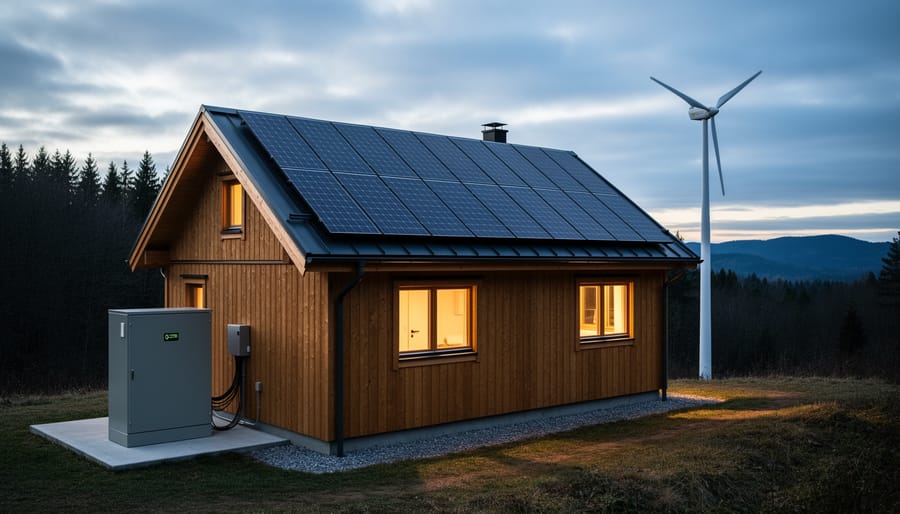
“Off the grid” describes a stand-alone electrical system that operates completely independently from the utility power network, relying entirely on self-generated energy (typically solar panels, wind turbines, or micro-hydro) paired with battery storage to meet all electrical needs. Unlike grid-tied systems that can feed excess power back to utility companies or draw electricity when production falls short, an off-grid setup forces you to generate, store, and manage every watt you consume without any safety net.
This independence comes with significant implications that many people underestimate when they first encounter the concept. You’re not just swapping one power source for another. You’re becoming your own utility company, responsible for calculating daily energy budgets, maintaining backup capacity for cloudy weeks or windless stretches, and designing a system large enough to cover peak demands while accounting for seasonal variations in sunlight or weather patterns.
The confusion surrounding “off the grid” often stems from marketing language that blurs the line between different renewable energy setups. A rooftop solar array connected to utility lines isn’t off-grid, it’s grid-tied. A cabin with solar panels but also a generator hookup occupies a hybrid middle ground. True stand-alone systems exist in isolation by design or necessity, whether powering a remote homestead miles from the nearest transformer or supporting someone who’s chosen complete energy independence as a lifestyle commitment.
Understanding this distinction matters because it shapes everything from equipment selection and upfront costs to daily habits and long-term maintenance. An off-grid system demands more batteries, larger solar arrays, and careful energy management compared to grid-tied alternatives. But for those willing to embrace the learning curve, it offers genuine self-sufficiency and freedom from monthly utility bills or power company dependencies.
What ‘Off the Grid’ Actually Means
When people say they’re living off the grid, they’re describing a complete break from the conventional power company. Your home becomes its own self-contained energy island, generating every watt you use and storing the surplus for when the sun sets or the wind dies down. There’s no meter on your wall tracking kilowatt-hours from the utility, no bill arriving each month, and crucially, no power lines connecting your property to the regional grid.
This independence distinguishes genuine off-grid systems from other renewable setups that still maintain utility connections. The differences matter more than most beginners realize:
- Off-Grid System
- A completely stand-alone installation with zero connection to utility infrastructure, relying entirely on on-site generation and battery storage. You’re responsible for producing and managing all your own power.
- Grid-Tied System
- Solar panels or wind turbines connected directly to the utility grid with no battery backup. Excess power flows to the grid for credits, but you lose power during outages just like your neighbors.
- Hybrid System
- Combines on-site generation with both battery storage and a grid connection, offering backup power during outages while maintaining utility access. This provides the reliability of batteries with grid support as a safety net.
Think of it this way: a grid-tied solar array is like having a garden that sells surplus produce to the grocery store but still shops there when your crops aren’t producing. A hybrid off-grid power system adds a root cellar to that garden, storing what you grow for lean times but keeping the store as backup. True off-grid living means you’ve closed the grocery store account entirely. Your root cellar better be well-stocked, and you better know how to preserve enough harvest to last through winter.
The stand-alone nature of off-grid systems creates both freedom and responsibility. You’re not subject to rate increases, service interruptions from distant storms, or infrastructure failures beyond your control. But you’re also the utility company, the maintenance crew, and the energy planner. When your batteries run low on a cloudy week in January, there’s no grid to fall back on. That reality shapes every decision about system design and daily energy use.
The Core Components of a Stand-Alone Renewable Energy System
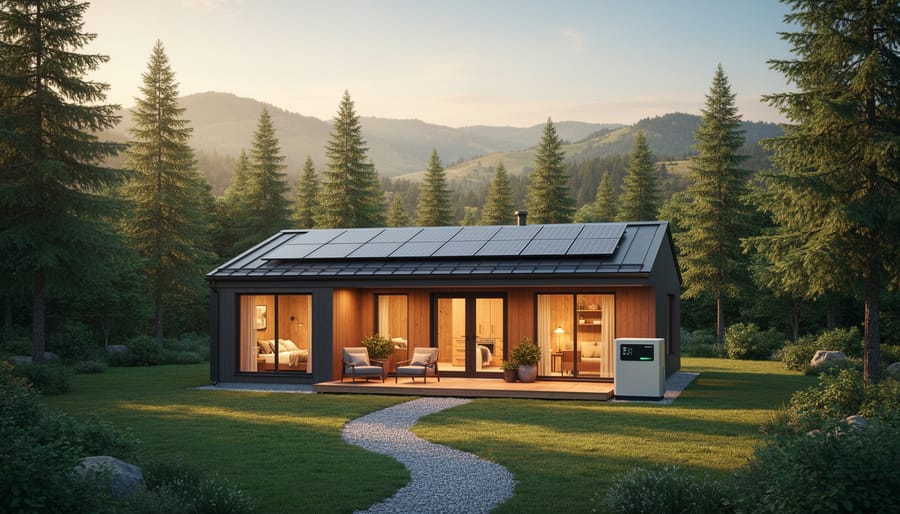
Energy Generation: Your Power Source
Your off-grid power generation begins with capturing energy from natural sources, and most stand-alone systems rely on three primary options: solar, wind, and micro-hydro. Each has distinct advantages depending on where you live and what resources your land offers.
Solar panels remain the most accessible choice for most off-grid homesteaders. They work reliably across diverse climates, require minimal maintenance, and scale easily from small cabin setups to full household systems. Even in northern latitudes with shorter winter days, modern panels generate meaningful power. The key consideration is orientation and tilt: panels facing south (in the Northern Hemisphere) at an angle matching your latitude capture maximum sunlight year-round. Shade from trees or structures kills output, so site assessment matters more than panel brand.
Wind turbines make sense if you have consistent winds averaging 10 mph or higher. They complement solar beautifully because windy conditions often coincide with cloudy weather. Small residential turbines need open space and proper tower height to escape ground turbulence. Neighbor considerations matter too, since turbines hum and cast moving shadows.
Micro-hydro systems deliver the most reliable power where flowing water exists. A small stream with sufficient drop can generate electricity 24/7, smoothing the peaks and valleys that challenge solar-only setups. The permitting process is more involved, but the consistent output often justifies the effort.
Most successful stand-alone systems combine generation methods. When you build an off-grid system pairing solar with wind or micro-hydro creates redundancy that carries you through weather extremes and seasonal changes.
Energy Storage: The Heart of Independence
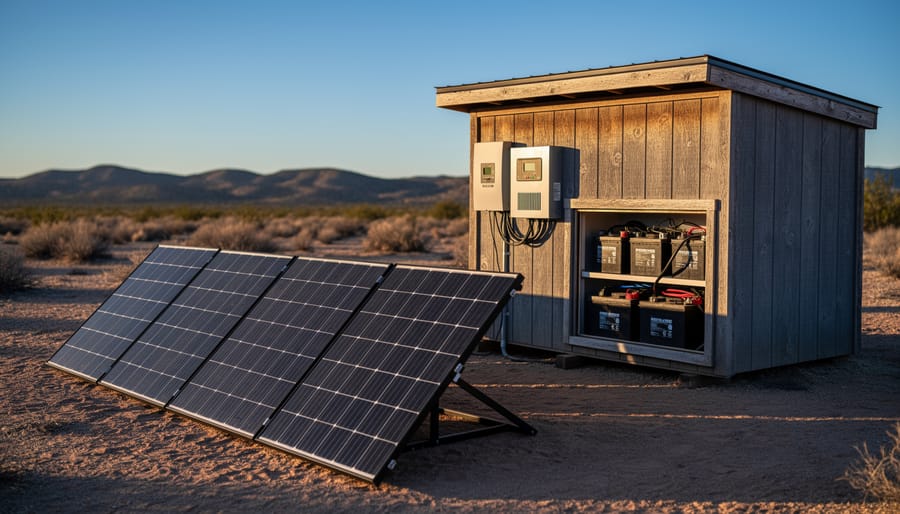
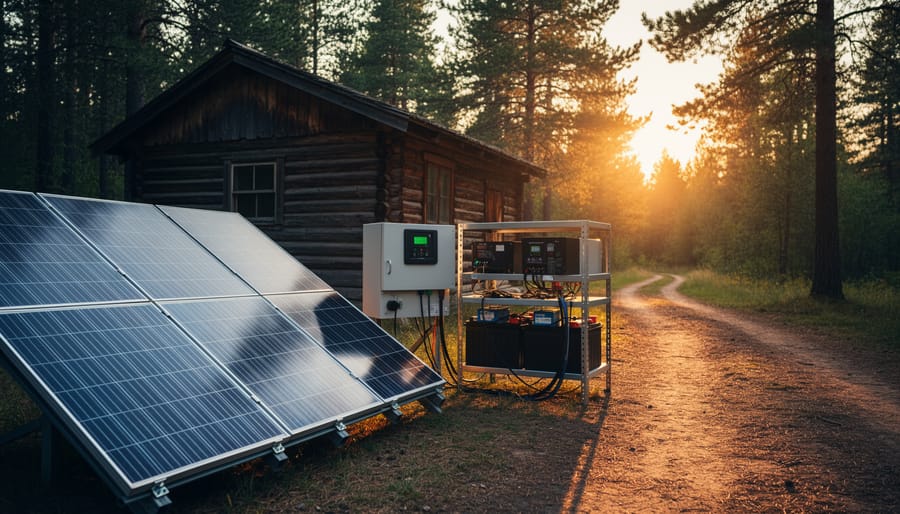
Your battery bank is the buffer between feast and famine in a stand-alone system. Without grid backup, every watt you generate when the sun’s shining needs somewhere to go for those hours (or days) when it isn’t. That stored energy powers your mornings before sunrise, carries you through cloudy stretches, and keeps essentials running during winter’s short days.
Most off-gridders start with lithium iron phosphate (LiFePO4) batteries or traditional flooded lead-acid banks. Lithium costs more upfront but lasts 3,000-5,000 cycles versus lead-acid’s 500-1,500. They’re also lighter, need zero maintenance, and deliver consistent power down to 20% capacity. Lead-acid batteries are proven technology and budget-friendly, but they require regular water checks and can only discharge to about 50% without damaging them.
Sizing off-grid battery banks starts with your daily energy consumption and how many days of autonomy you want. Three days is common for areas with reliable sun; five to seven days suits cloudier climates. If you use 5 kWh daily and want three days’ backup, you need at least 15 kWh of usable capacity, which translates to 30 kWh of lead-acid (accounting for the 50% discharge limit) or 18-19 kWh of lithium (with deeper discharge safety margin).
A friend who went too small learned this the hard way. Two cloudy days and his batteries hit bottom, forcing him to fire up the generator at 2 a.m. Now he plans for four days minimum.
Charge Controllers and Inverters: Managing Your Power
Between your solar panels and batteries sits a piece of equipment most beginners overlook until something goes wrong: the charge controller. Think of it as your battery’s bodyguard. When sunlight floods your panels with electricity, the controller steps in to prevent overcharging, which can permanently damage expensive batteries. It regulates the voltage coming in, ensuring your batteries charge safely and completely.
I learned this the hard way during my first winter off-grid. Without understanding my PWM controller’s limitations in cold weather, I wondered why my batteries never reached full charge. Upgrading to an MPPT controller, which extracts up to 30% more power from panels, especially in low-light conditions, solved the problem immediately.
The inverter handles the opposite challenge: most household appliances run on alternating current (AC), but your batteries store direct current (DC). The inverter bridges this gap, converting stored DC power into usable AC electricity for your lights, refrigerator, and power tools.
Pure sine wave inverters cost more than modified sine wave models, but they’re worth it. They run sensitive electronics without the buzzing, overheating, or shortened lifespan that cheaper inverters cause. I’ve watched modified sine wave inverters destroy laptop chargers and create interference in audio equipment.
Together, these components form your system’s control center, managing the delicate balance between generation, storage, and consumption that defines true energy independence.
Why Stand-Alone Systems Require Different Thinking
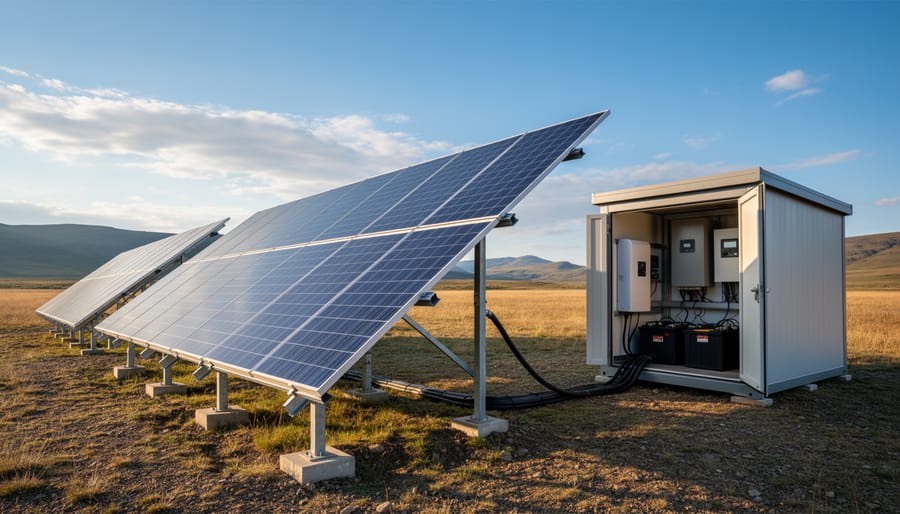
When I first moved to my off-grid cabin, I treated my solar setup like the utility grid I’d left behind. Flip a switch, power flows. Run the washing machine, microwave, and laptop simultaneously? No problem, right? Wrong. I learned quickly that stand-alone systems demand a completely different relationship with energy.
The biggest shift is becoming intimately aware of what energy actually is and where it comes from. On the grid, electricity feels infinite because you’re drawing from massive generating stations and thousands of miles of transmission lines. In a stand-alone system, you’re limited to what your panels generated yesterday, what your batteries stored, and what the weather allows today. That washing machine suddenly becomes a decision: Do I have enough stored power? Is the sun shining to supplement the load? Can this wait until tomorrow when conditions might be better?
This awareness extends to everything you plug in. You start calculating in watt-hours rather than just convenience. A hairdryer stops being a quick grooming tool and becomes a 1,500-watt beast that’ll drain a quarter of your battery bank in ten minutes. You learn which appliances are energy vampires (hello, old refrigerators and phantom loads) and which earn their keep. It’s not restrictive once you adjust. It’s clarifying. You make conscious choices instead of mindless consumption.
Seasonal planning becomes second nature. Winter where I live means fewer daylight hours and panels often covered in snow. I’ve learned to run heavy loads in summer and early autumn, when generation outpaces consumption and batteries stay topped off. Come December, I shift to conservation mode. Laundry happens on sunny days. I batch cook to minimize propane use. I read more books by lamplight instead of streaming shows. These aren’t sacrifices; they’re rhythms that align with natural cycles.
The need for reliable backup power reveals another crucial difference. Grid-tied folks rarely think about redundancy. Your stand-alone system, though, needs layers. I learned this during a stretch of cloudy weather that coincided with unusually cold temperatures requiring more heating than planned. My battery bank dropped to twenty percent. Since then, I’ve added a small generator for those rare but real gaps. Some off-gridders use wind to complement solar. Others incorporate micro-hydro if they have flowing water. The point is accepting that renewable generation varies and planning accordingly.
You also develop a forecasting habit. Checking tomorrow’s weather isn’t about packing an umbrella. It’s about knowing whether you can run that power-hungry tool or should postpone until conditions improve. You watch your battery voltage the way sailors watch the horizon, reading subtle signs that indicate coming abundance or scarcity.
This different thinking isn’t a burden. It’s a reconnection. You become aware of energy as a resource, weather as a partner, and your own consumption patterns as choices rather than automatic behaviors. The learning curve is real, but it leads somewhere worth going.
Sizing Your Stand-Alone System: Getting the Balance Right
Getting your system size right is probably the single most important decision you’ll make when building a stand-alone power setup. Too small, and you’ll be constantly rationing power or running a generator. Too large, and you’ve spent thousands on capacity you’ll never use. I learned this the hard way during my first winter off-grid, when I discovered my modest 2kW solar array couldn’t keep up with November’s shortened days and my very ordinary energy habits.
The good news? You don’t need an engineering degree to get this right. You just need honesty about your actual energy use and willingness to track some numbers.
- Track your current energy consumption for at least a full week, ideally a month. Write down every appliance you use, how long it runs, and its wattage. Your laptop charger, coffee maker, phone charger, lights, water pump, everything. This isn’t guesswork territory.
- Calculate your daily watt-hours by multiplying each appliance’s wattage by hours of daily use, then sum everything. A 100-watt laptop running 4 hours equals 400 watt-hours. Do this for your entire day, and you’ll have your baseline daily consumption.
- Add a 25-30% buffer for inefficiencies and unexpected use. Real-world systems lose energy through conversion, battery charging cycles, and inverter standby draw. If your calculation shows 3,000 watt-hours daily, plan for around 3,900 watt-hours of actual generation capacity.
- Size your battery bank to store at least three days of your buffered consumption, giving you autonomy during cloudy stretches. For that 3,900 watt-hour daily need, you’re looking at roughly 11,700 watt-hours of battery capacity, though many experienced off-gridders recommend four to five days for true peace of mind.
- Calculate your generation capacity based on your location’s worst-case solar hours or wind conditions. If winter gives you only 2.5 peak sun hours daily and you need 3,900 watt-hours, you’ll need at least 1,560 watts of solar panels, though I’d recommend 2,000 watts to account for panel degradation and less-than-ideal mounting angles.
Here’s a real example from a contributor who lives in northern Idaho. His household runs a refrigerator, LED lighting, laptops for remote work, a well pump, and occasional power tools. His daily consumption averages 5,200 watt-hours in summer, jumping to 6,800 in winter when days are shorter and he’s indoors more. He sized his system with 3,600 watts of solar panels, 800 amp-hours at 24 volts (19,200 watt-hours) of lithium battery storage, and a 2,000-watt backup generator. Winter weeks with persistent cloud cover require running the generator every third day for a few hours, which he considers acceptable.
Seasonal variation deserves special attention. Your December energy production might be 40% of your July output, even with the same number of panels. Plan for your lean season, not your abundant one. Some folks add extra panels specifically for winter, accepting they’ll have surplus capacity in summer. Others integrate a small wind turbine to catch winter storms when solar production drops.
The biggest mistake? Designing for average conditions rather than worst-case scenarios. Your system needs to work during that week of January fog, not just sunny spring days.
Common Mistakes When Building Stand-Alone Systems
Building a stand-alone system is a learning journey, and most of us make at least a few missteps along the way. The good news is that these mistakes are predictable, which means you can avoid them with a bit of foresight. Here are the most common pitfalls I’ve seen (and experienced) in off-grid builds, along with straightforward ways to sidestep them.
The biggest mistake? Undersizing your battery bank. It’s tempting to save money upfront by buying fewer batteries, but this almost always backfires. A battery bank that’s too small for your needs will cycle deeply every day, dramatically shortening its lifespan. You’ll end up replacing batteries far sooner than necessary, spending more in the long run than if you’d sized properly from the start. Aim for a battery bank that allows you to use only 30 to 50 percent of its capacity on a typical day. This gives you buffer for cloudy weather and extends battery life considerably.
Another frequent error is neglecting backup generation entirely. Solar panels are wonderful, but relying solely on them means you’re one broken charge controller or string of overcast days away from sitting in the dark. A small generator, even if you only run it occasionally, provides essential redundancy. Think of it as insurance rather than failure.
Many newcomers also overestimate their generation capacity while underestimating actual energy use. Those solar panel specifications? They’re based on ideal laboratory conditions you’ll rarely see in the real world. Factor in dirt, angle, temperature effects, and seasonal sun variations. Similarly, we’re remarkably good at convincing ourselves we’ll use less power than we actually do. Track your current usage honestly before sizing your system.
Skimping on wire gauge is another costly shortcut. Undersized wiring creates voltage drop, meaning power generated by your panels never makes it to your batteries efficiently. It also generates heat, creating fire risk and wasting energy. Use properly sized cables even though thicker wire costs more upfront.
Finally, many people rush the installation without adequate testing and monitoring. Install proper monitoring equipment from day one so you can actually see what your system is doing. This helps you catch problems early, understand your energy patterns, and make informed decisions about usage.
Remember, building a stand-alone system is an iterative process. Start conservatively, monitor closely, and expand thoughtfully as you learn your actual needs. Most mistakes are fixable, and each one teaches you something valuable about living independently.
Making the Transition to Stand-Alone Power
The jump from grid power to a stand-alone system doesn’t have to happen overnight. In fact, the most successful transitions I’ve witnessed happen in stages, where you build skills and confidence alongside your infrastructure.
Start small with a test system that powers just one room or specific appliances. A contributor in Vermont ran her home office on a modest solar setup for six months before expanding further. This trial period taught her actual consumption patterns versus theoretical calculations, and she discovered her laptop used half the power she’d estimated while her laser printer was an energy hog she hadn’t accounted for. These insights shaped her full-system design and saved thousands in oversized components.
During this testing phase, keep your grid connection active. Yes, this seems contrary to the goal, but it’s your safety net while you learn the rhythms of renewable energy. You’ll experience cloudy weeks in winter, understand how cold temperatures affect battery performance, and develop an intuitive sense for rationing power during lean periods. These lessons are invaluable before you’re fully committed.
As you scale up, focus on efficiency first. Every watt you eliminate from your baseline consumption is cheaper than generating and storing that watt. A contributor in New Mexico replaced all her lighting with LEDs, switched to a propane fridge, and discovered she could eliminate her electric water heater entirely, cutting her projected system size by forty percent. Building a self-sufficient homestead means rethinking every energy assumption you’ve made.
Plan your disconnection for late spring or early summer when generation is strongest and you’re learning under favorable conditions. Before cutting the cord, verify you can live off-grid legally in your area, as some jurisdictions mandate grid connections for occupied dwellings.
The first month truly off-grid feels different. You’ll check your battery voltage compulsively, celebrate sunny days, and probably run your backup generator more than expected. This adjustment period is normal. Most people find their energy awareness becomes second nature within three months, and by six months, managing their stand-alone system feels as routine as flipping a light switch once did.
Living truly off the grid with a stand-alone system isn’t just about cutting the cord to the utility company. It’s about reclaiming a fundamental relationship with your energy use, understanding where every watt comes from and where it goes. Yes, there’s a learning curve. You’ll make mistakes sizing your battery bank, misjudge your consumption on cloudy weeks, or run your generator more than you planned in that first winter. That’s part of the journey, not a failure.
What makes it worthwhile is the profound shift in how you experience daily life. You’ll notice the angle of the sun differently. You’ll become more attuned to weather patterns. You’ll learn which appliances really matter and which were just convenience clutter. Most importantly, you’ll discover that energy independence brings a quieter confidence that extends beyond just keeping the lights on.
Start where you are. Maybe that means running calculations for a future cabin, or perhaps you’re already living off-grid and fine-tuning your setup. Either way, remember that every experienced off-gridder was once standing exactly where you are now, wondering if they could really pull this off. They figured it out through doing, adjusting, and learning from the system itself.
Your stand-alone renewable energy system won’t just power your home. It’ll prove to you, every single day, that self-sufficiency isn’t a fantasy reserved for experts. It’s a practical reality you can build, one component and one lesson at a time.